
How Venti and Aether Became Unwitting Symbols in a Turkish Media Storm
A Turkish TV segment's criticism of Genshin Impact's Venti and Aether as unmasculine sparks a fierce global fan defense.
In late 2025, a fragment of Turkish television drifted into the digital airspace of the Genshin Impact community and detonated like a misplaced firework. A news segment on Ülke TV, a channel not typically associated with video game critique, had trained its bewildered gaze on the Anemo Archon Venti and the male Traveler Aether, dissecting their character designs with the panicked energy of cartographers staring at a sea monster on a medieval map. The broadcast, part of a discussion on children and digital identity, questioned the masculinity of these two heroes with a scrutiny that felt less like media analysis and more like a relic of bygone moral panics. What followed was a cascade of reactions that turned a strange television moment into a global conversation about art, gender expression, and the protective ferocity of gacha gamers.
The segment, aired on November 21, 2025, and later shared widely on YouTube, saw panelists examining Aether’s exposed midriff as though it were a forbidden text, while Venti’s androgynous appearance and soft voice prompted visible consternation on camera. Even through the blur of machine translations and auto-generated subtitles, the intent was unmistakable: a conservative interrogation of the game’s gender politics that treated fictional characters like threats to societal order. The panelists, operating from a worldview that seemed to view any deviation from rigid masculine archetypes as inherently problematic, inadvertently performed a cultural time capsule — their arguments felt roughly as relevant as a debate over whether women should ride bicycles. When Venti appeared on screen, one speaker fumbled for terminology and landed on “nonbinary,” a word wielded not with understanding but as a pejorative brushstroke.
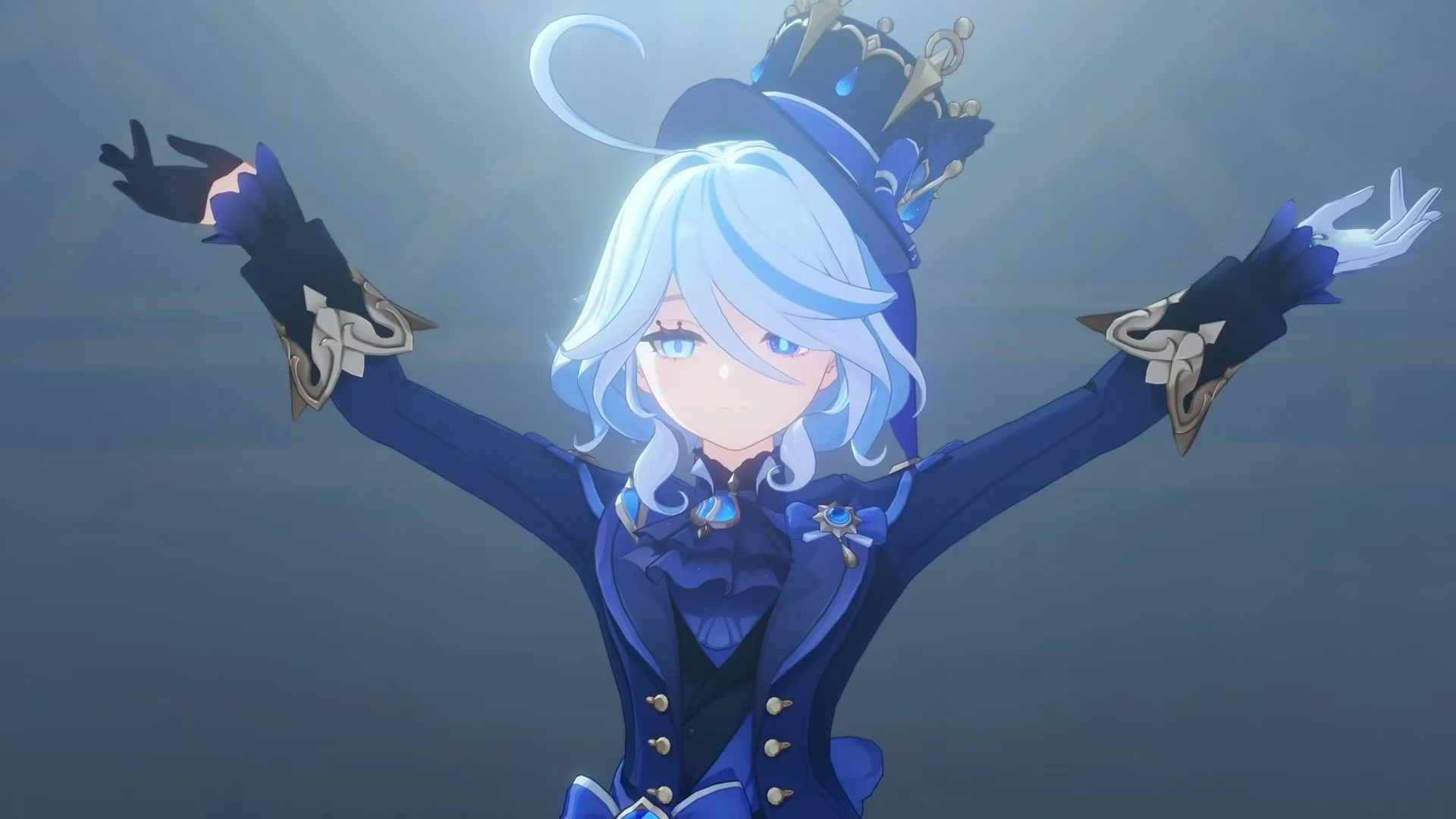
The Genshin Impact community, however, responded not with silence but with the orchestral force of a thousand storm eyes. Fans descended on the Ülke TV YouTube archive like a digital immune system sensing an alien pathogen, swelling the view count far beyond the channel’s usual metrics and littering the comments section with a multilingual defense of their beloveds. The dislike ratio — visible through browser plugins — painted a picture of overwhelming rejection. Comments translated from Turkish, English, Spanish, and dozens of other languages formed a protective wall. “We won’t let Aether be eaten by people like you,” declared one viewer. Another, sharper in wit, observed: “I had no idea that adults and mature people could make such childish comments about non-issues.” The absurdity had been answered in kind.
Reddit and dedicated Venti communities erupted with a mixture of humor and righteous indignation. One user, Saahil_08, wrote, “How dare they mock my cutie patootie like that,” capturing the affectionate annoyance that defines so much of fandom culture. Shizuna03 drew a historical parallel: “This is a modern day version of ‘Teletubbies are satan worshippers.’” The comparison was apt, pointing to a recurring phenomenon where older generations misread innocent media through a lens of fear. Others were more direct: “They hate him because they ain’t him,” argued Venttea, a sentiment that distilled the debate into a single, self-evident truth for those who understand Venti’s charm.
Yet beyond the mockery lay a deeper loyalty. Aether serves as the emotional anchor of Genshin Impact’s sprawling narrative — a silent protagonist whose journey through Teyvat has anchored millions of players since the game’s 2020 launch. For many, the male Traveler is not a collection of pixels to be critiqued but a surrogate self, an avatar woven into memories of exploration and triumph. Venti, meanwhile, is among the most beloved Archons, his playful surface hiding layers of poetic sorrow and political nuance. To see these figures reduced to props in a moralizing segment felt to fans like watching a librarian be accused of sorcery in broad daylight.
By early 2026, the incident had already become a cherished piece of community lore, partly because Venti was in the midst of a long-awaited renaissance. After more than five years, HoYoverse finally delivered substantial buffs to the Anemo Archon, modernizing his crowd-control capabilities and energy regeneration in ways that made him a freshly competitive pick in high-level team compositions. Players who had mained Venti since the game’s earliest patches celebrated the update as vindication, a mechanical embrace that mirrored their emotional one. The news segment, then, landed not as a blow to morale but as a bizarre footnote in a much larger story of resurgence.
That resurgence is emblematic of how Genshin Impact’s character design continues to resonate across cultures. The game thrives on a spectrum of masculinity and beauty that refuses binary boxes — from the floral elegance of Lyney’s performances to the sly androgyny of Heizou’s detective guise. If the Ülke TV panelists were rattled by Venti, one can only imagine the apoplexy that would follow an encounter with an official HoYoverse illustration of Heizou lounging in his full, ambiguous glory. The humor of the community’s response lay in this future-tense dread: “Don’t let them find Lyney,” warned one Reddit post, seeing the magician as the next potential victim of a bewildered broadcast.
The entire affair serves as a case study in how digital games can function as cultural lightning rods. A Turkish news segment, itself a small ripple in a vast media ocean, was amplified by a global audience that refused to cede the meaning of its favorite characters to outsiders. The panelists, in trying to frame Genshin Impact as a vector for gender confusion, instead became the living embodiment of a generation gap so wide it could swallow a continent. Their confusion over a bare belly button and a femboy-like archon revealed how ill-equipped certain corners of traditional media are to engage with the fluid visual languages of anime and game art.
For the players, the victory was not in changing minds but in the joyful act of collective refusal. When a community protects its icons not out of obligation but out of genuine love, the result is a fortress made of laughter, memes, and the occasional savage comment. If the Ülke TV incident teaches anything, it is that Venti and Aether are far beyond the reach of clumsy criticism. They have become symbols not just within the game, but of a communal identity — and that identity, like anemo itself, cannot be caged.