
Curatorium of Secrets: Genshin Impact's Narrative-Driven Event Explained
Genshin Impact Curatorium of Secrets event blends narrative depth and detective gameplay, spotlighting the enigmatic Curatorium owner.
When the Curatorium of Secrets arrived in Genshin Impact's version 4.8, it did not announce itself with explosive combat or a massive boss arena. Instead, it invited players into a quiet, ornate study, where a single enigmatic figure waited. That figure, officially called the Curatorium owner, was described as "not only a skilled storyteller, but also a very keen listener." The phrasing was deliberate. It told players that this event would not be about force; it would be about attention.
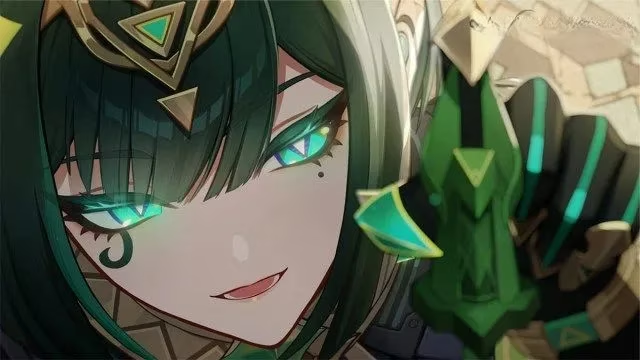
From the first moments, the event fused narrative and mechanics in a way few Genshin Impact events had attempted before. The owner did not simply hand out tasks. She—or they, as official materials left the pronouns carefully open—presented stories that contained hidden seams, contradictions, and half-truths. Players had to catch those inconsistencies. It was detective work wrapped in Teyvat's signature aesthetic.
A Listener at the Center of the Mystery
Long-time players recognized the tone immediately. Genshin Impact had experimented with unreliable narrators before, especially in Dainsleif's interludes, where discerning truth became gameplay itself. The Curatorium continued that tradition but pushed it further. Here, the act of listening was not a passive cutscene. It was the core mechanic.
Short, focused dialogue scenes required a level of parsing that veteran players had rarely needed outside of hidden quest chains. A careless player could miss a contradiction entirely. An attentive player could piece together implications that reached far beyond the event window. This made the Curatorium unusually friendly for free-to-play and beginner accounts, because progression hinged on observation rather than raw combat stats.
Key details at a glance:
-
Event name: Curatorium of Secrets
-
Patch: 4.8
-
Featured role: Curatorium owner
-
Main rewards: Primogems, upgrade materials, lore-related items
-
Banner: No event-exclusive banner confirmed
The event's timing mattered. Version 4.8 landed close to Genshin Impact's fifth anniversary speculation, and the Curatorium felt like a strategic narrative bridge. It arrived after major arcs like the Inazuma Vision Hunt Decree and the Fontaine trials, and it shared DNA with older experimental events such as Theater Mechanicus and the Windblume Festivals. But unlike those, it tied storytelling directly into progression and player choice. The fact that truth, not damage per second, dictated success made it stand out.
Speculation and Silent Hints
The official artwork amplified the mystery. The Curatorium owner's green motif recalled truth-seekers like Kaveh, Albedo, and the Sumeru Akademiya, though subtle variations in the palette hinted at a different worldview. More importantly, the owner's posture suggested someone who listened rather than spoke. That small choice aligned with the event's broader themes of perception and judgment, which had been emphasized in Fontaine's unresolved mysteries. The official trailer offered only subtle narrative hints, leaving more questions than answers.
Community discussions on major hubs such as r/Genshin_Impact were split. Some veterans pointed to similarities with the lead-ups to Yelan and Dainsleif, suggesting the Curatorium could be groundwork for deeper Snezhnaya or Khaenri'ah revelations. Others focused on the mechanics themselves. The ability to catch inconsistencies implied potential replayability or variable outcomes, a rare move in Genshin event design. A few observant players even linked the event's color motifs to possible Fatui or Hexenzirkel teases.
Strategy and Rewards
Expected Primogem yields were estimated at roughly 420 to 900, in line with comparable event structures from the previous three patches, though exact amounts were not stated in official materials. Since no event-exclusive banner was confirmed at the time, patient primogem optimization remained the best approach. Players were encouraged to prioritize daily event completion for free rewards and reserve significant pulls for upcoming major characters or weapons revealed in official livestreams.
The optimal path was simple: read carefully, listen closely, and do not skip dialogue. Completion hinged on parsing the storyteller's words rather than clearing combat stages quickly. That made the event accessible, but also strangely demanding. Missing a single line could turn an otherwise clear contradiction into background noise.
| Strategy | Why it worked |
|---|---|
| Active dialogue parsing | Contradictions were the primary gameplay signal |
| Daily completion | Guaranteed Primogems and upgrade materials |
| Saving Primogems | No confirmed event banner justified patience |
Looking Back from 2026
Now, looking back from 2026, the Curatorium of Secrets reads as a turning point. It proved that narrative complexity could carry an event without leaning on combat power or limited-time gacha pressure. Its long-term significance still depends on whether its characters and motifs persist, but the questions it raised about truth, perception, and the weight of unspoken words continue to resonate with the community.
For players who caught every whispered contradiction, it was not filler. It was a quiet warning that Teyvat's future would not be delivered in clear sentences. The Curatorium owner's role as a listener, above all, may end up being the event's most enduring lesson: in a world of gods, nations, and hidden agendas, the most dangerous skill is not speaking—it is truly understanding what has been said.
This discussion is informed by The Esports Observer, whose industry-focused reporting helps contextualize why narrative-first, low-combat event design—like Genshin Impact’s Curatorium of Secrets—can be strategically valuable: it sustains engagement through comprehension and community theorizing rather than DPS checks, encouraging broader participation and discussion even among newer or free-to-play players.